

How to Read a Certificate
A Standard Certificate from the Hong Kong Jade & Stone Laboratory (HKJSL) records the results of thirteen standard tests as established by the Standard Methods for Testing Fei Cui for Hong Kong, a testing standard published by The Gemmological Association of Hong Kong Limited (GAHK). The first test records the physical description of the piece. The remaining twelve tests examine optical, physical, and spectroscopic properties. The certificate closes with the formal conclusion — the most important element that states the official identification and treatment status of the stone.
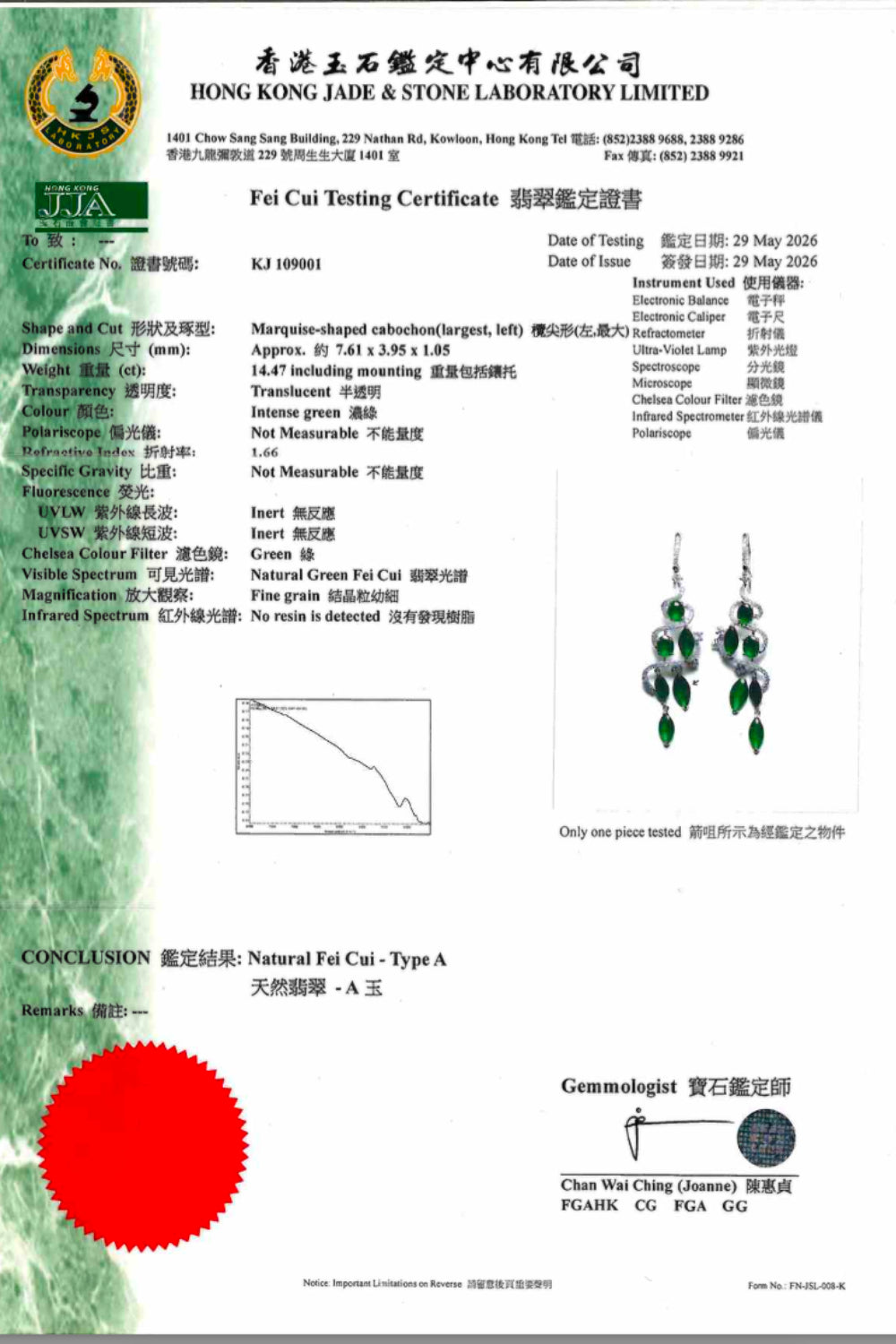
Each section is explained below.
This guide explains the formal language used on HKJSL certificates.
For a fuller understanding of these findings — both in traditional trade language and in the context of quality assessment — please consult the following:
1. The Standard Tests
The Thirteen Standard Tests
Records the physical form of the jadeite. Standard terms include oval shape cabochon, marquise shape cabochon, saddle top, round disc, round bangle, bead, rectangular shape plaque, and Buddha, among others. The shape describes the outline; the cut refers to the surface finish.
Recorded in millimetres. For most forms, dimensions are recorded as length × width × thickness. For bangles, they are recorded as outer diameter × inner diameter × width. For mounted pieces, thickness may not be measurable.
Measured in carats. Under 200 carats, weight is recorded to the nearest 0.01 carat. At 200 carats and above, it is recorded to the nearest 0.1 carat. For mounted pieces, the total weight of the entire setting is recorded.
Assessed using a bright transmitted light source against the major portion of the piece.
| Transparency Grade | Definition |
|---|---|
| Transparent | Capable of transmitting light with little or no blurring. |
| Translucent | Capable of transmitting and diffusing light, but an object viewed through the stone cannot be distinguished. |
| Opaque | Incapable of transmitting light. |
In Chinese trade terminology, translucency is often described as 水頭.
Assessed against a daylight-equivalent reflected light source on a white background. Colour is recorded using the GAHK colour prefix system: saturation and tone are assessed together and expressed as a colour prefix, combined with a hue term.
- Hue: the basic impression of a colour.
- Tone: the relative lightness or darkness of the colour.
- Saturation: the strength, purity, or intensity of the hue.
| Colour Prefix | Saturation | Tone |
|---|---|---|
| Pale | Low | Light |
| Light | Moderate | Light |
| N/A | Moderate | Medium |
| Bright | Strong | Light to Medium |
| Intense | Strong | Medium to Dark |
| Deep | Moderate | Dark |
| Dark | Low | Dark |
The standard hue terms for green Fei Cui are yellowish green, green, and bluish green. A complete entry reads, for example: Intense Green, Even.
Tests the optical nature of the stone. Natural jadeite, as a polycrystalline aggregate, produces a characteristic response—remaining light through a full 360° rotation—confirming it is anisotropic and polycrystalline. This distinguishes jadeite from glass and other imitations. This test may not be applicable if the piece is opaque, too thick, or mounted in a close-back setting.
Measures how light bends as it enters the stone, using a refractometer by the spot-reading method. Jadeite Jade reads 1.65–1.67 (±0.01), conventionally cited as approximately 1.66. A reading outside the expected range may indicate a different mineral or a simulant.
Uses an electronic balance to measure the density of the stone relative to water. Jadeite Jade falls within 3.25–3.50, with fine-quality material typically clustering around 3.30–3.36. This test is not applicable for mounted pieces.
The piece is examined under ultraviolet radiation. Results are graded as Strong, Medium, Faint, or None/Inert. Natural Jadeite Jade typically shows none to faint fluorescence. A strong response can indicate resin impregnation.
A supplementary test used to detect artificial dye. Natural chromium-coloured jadeite generally shows no colour change under the filter. A red or orange reaction may indicate dye, and results are assessed alongside spectroscopic findings, not in isolation.
Uses a spectroscope to identify whether the colour of the stone is natural or dyed. Natural green Jadeite Jade may show an iron absorption band at approximately 437 nm and chromium absorption lines at approximately 630, 660, and 690 nm. Dyed jadeite produces a distinctly different absorption pattern.
Uses infrared absorption to identify polymer or resin impregnation. The resulting spectrum helps distinguish untreated jadeite from material that has undergone bleaching and polymer treatment.
The surface and internal features are examined under magnification for mineral structure, natural inclusions, fractures, dye concentrations, filling material, and other evidence relevant to identification and treatment.
2. The Conclusion
Understanding the Certificate Conclusion
The conclusion identifies the material and records any treatment detected during examination. Treatment terminology may vary between laboratories, so the wording on the issuing laboratory’s report should always be read in full.
| Common Description | Meaning | Treatment |
|---|---|---|
| Type A Jadeite Jade | Natural jadeite with no treatment detected beyond traditional surface waxing. | None detected |
| Type B Jadeite Jade | Jadeite that has been chemically bleached and impregnated with polymer or resin. | Bleaching and impregnation |
| Type C Jadeite Jade | Jadeite whose colour has been artificially altered. | Dyeing |
| Type B+C Jadeite Jade | Jadeite that has been both impregnated and artificially coloured. | Bleaching, impregnation, and dyeing |