

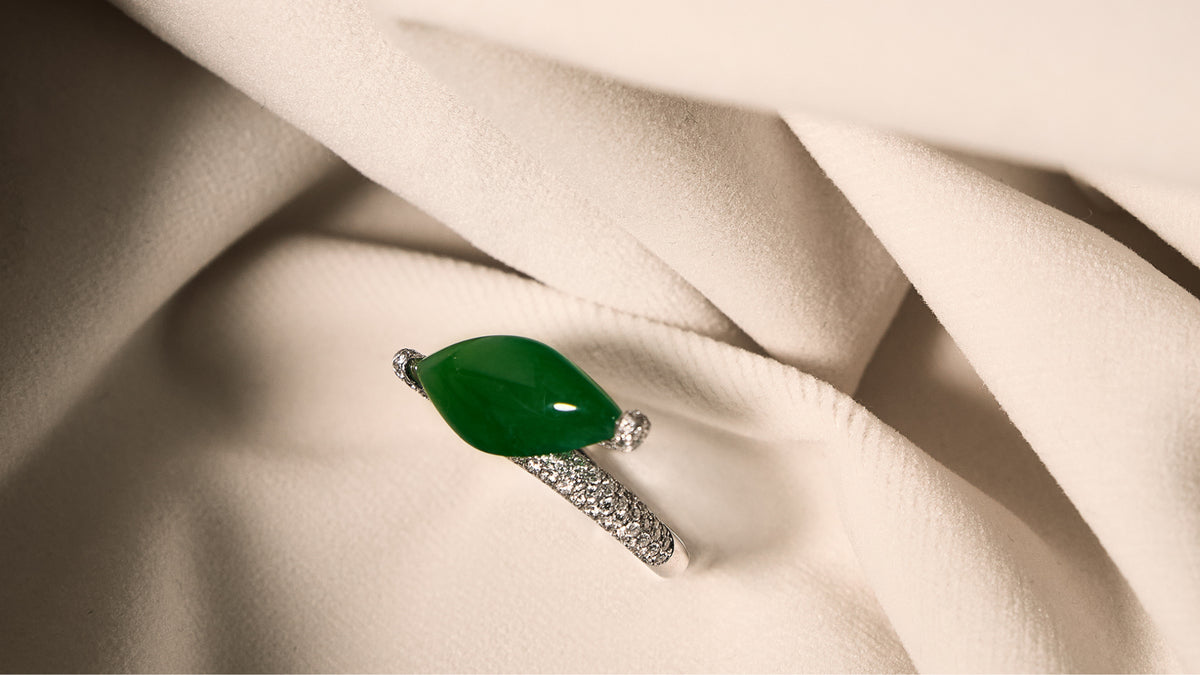
About Jadeite
Terminology in the jadeite trade often differs from the formal, standardised language used on gemmological certificates. While laboratory reports document measurable properties and treatment status, the trade relies on a centuries-old vocabulary built around structural integrity, light behaviour, and visual impression — including assessments of colour, type (種), translucency (水頭), and phenomena such as internal luminescence (起螢). Many of the criteria described in this guide are trade observations rather than calibrated test results. They exist as visual and tactile impressions as much as measurable properties, and will not appear on a certificate. Yet they remain the primary language used by collectors and dealers—and the first qualities a trained eye assesses in exceptional material.
This guide is grounded in over fifty years of family experience, dedicated market research, and founder-led assessment. Where trade terminology corresponds to the Standard Methods for Testing Fei Cui for Hong Kong, a testing standard published by The Gemmological Association of Hong Kong Limited (GAHK), we have noted the alignment for your reference. The jadeite industry currently lacks a universal standard that integrates traditional trade terminology into laboratory certification. This gap is precisely why SÈVE developed its own evaluation framework: to translate these nuanced, experiential qualities into a clear, consistent language for collectors.
This guide explains both systems to help you navigate certificates, engage confidently in trade conversations, and refine your own assessment.
For further guidance on certification standards, care practices, or how SÈVE applies these criteria to selection:
1. Jade, Fei Cui, and Jadeite
1.1 Yu (玉) — Where It Begins
When most people think of jade, they are thinking of 玉 (jade) — the luminous stone venerated in Chinese culture for over 7,000 years. The stone of Confucian virtue, imperial ritual, and dynastic jade artefacts.
For most of history, jade referred to nephrite (軟玉), the softer, more common form found throughout China. In the Ming Dynasty, a new stone arrived from Myanmar: jadeite (硬玉), harder, more luminous, and far rarer.
1.2 Jade Is a Family Name
What we call "jade" today is not a single stone. It is a family name shared by four chemically distinct minerals.
| Mineral | Chinese Name | Group | Chemical Formula |
|---|---|---|---|
| Nephrite Jade | 軟玉 | Amphibole | Ca₂(Mg,Fe)₅Si₈O₂₂(OH)₂ |
| Jadeite Jade | 硬玉 | Pyroxene | NaAlSi₂O₆ |
| Omphacite Jade | 綠輝石 | Pyroxene | (Ca,Na)(Mg,Al)Si₂O₆ |
| Kosmochlor Jade | 鈉鉻輝石 | Pyroxene | NaCrSi₂O₆ |
1.3 Fei Cui (翡翠) — The Formal Definition
Fei Cui (翡翠) is the formal family name for three related pyroxene-group minerals: Jadeite Jade (NaAlSi₂O₆), Omphacite Jade [(Ca,Na)(Mg,Al)Si₂O₆], and Kosmochlor Jade (NaCrSi₂O₆)¹. In modern gemmological and commercial usage, Fei Cui has become synonymous with jadeite specifically — reflecting jadeite's dominance in the trade, at auction, and in serious collections worldwide.
SÈVE works exclusively with Jadeite Jade, the most studied and commercially prized of the three.
1.4 How Fei Cui Got Its Name
The name Fei Cui (翡翠) has two origin stories — both explanations coexist in the historical record, and neither contradicts the other.
The first is poetic. Jadeite's colours are rarely uniform — its beauty lies in the interplay of deep green against a pale base, sometimes accompanied by flashes of red and russet. This vivid range reminded the Chinese of two birds: Fei (翡), the male kingfisher with its crimson plumage, and Cui (翠), the female with her emerald feathers. What finer way to name a beautiful stone than after beautiful birds?
The second is linguistic. In ancient times, Cui (翠) was the specific term for the green jade produced in Xinjiang's Hetian region. When Burmese jadeite entered China since the Ming dynasty, it needed to be distinguished from the Hetian jade already known and revered. It was called Fei Cui (非翠): literally "not Hetian jade." Over time, 非翠 evolved into the 翡翠 we know today.
1.5 What Is Jadeite?
Jadeite is a sodium aluminium silicate mineral with the chemical formula NaAlSi₂O₆, belonging to the pyroxene group. It forms not as a single crystal but as a polycrystalline aggregate — a dense interlocking mass of microscopic crystals.
This interlocking structure gives jadeite exceptional toughness, distinguishing it from many gemstones of comparable hardness. Hardness measures resistance to surface scratching; toughness measures resistance to fracture. It is jadeite's toughness — born from its granular, interlocking architecture — that makes it suited to both intricate carving and daily wear.
1.6 Jadeite and Nephrite: The Differences That Matter
| Jadeite (硬玉) | Nephrite (軟玉) | |
|---|---|---|
| Mineral family | Pyroxene | Amphibole |
| Hardness (Mohs) | 6.5–7 | 6–6.5 |
| Toughness | Exceptional (resists fracture due to interlocking crystals) | High (resists fracture due to fibrous structure) |
| Texture | Interlocking granular | Fibrous, waxy |
| Translucency | Opaque to highly translucent | Typically opaque to translucent |
| Colour range | Green, lavender, red, yellow, white, black | Green, white, black, brown |
| Primary source | Myanmar (over 95%), Guatemala, Russia, Japan | Canada, New Zealand, Siberia, China |
| History in China | Since the Ming dynasty | Venerated for 7,000+ years |
| Value | Fine jadeite commands substantially higher prices; exceptional specimens set records at major international auctions | Prized, particularly fine Hetian nephrite, though generally lower in value than comparable jadeite |
¹ References: Hong Kong Jade and Stone (Control) Ordinance, Cap. 362K; Standard Methods for Testing Fei Cui for Hong Kong (GAHK, 2016).
2. Colour and the Four Standards
2.1 Chemistry of Colour
Colour in jadeite is determined by trace elements within the crystal structure. The two primary chromophores are iron and chromium.
Iron (Fe³⁺) contributes to the broad green spectrum found in most jadeite — from pale grey-green to deeper, more muted tones.
Chromium (Cr³⁺) is responsible for the vivid, saturated greens associated with the highest-value material. Where chromium concentration is high, the colour becomes intensely bright and pure — the quality known in trade as Imperial Green (帝王綠). As chromium enrichment increases toward the upper extreme of the spectrum, the mineral composition shifts progressively along the jadeite-kosmochlor solid solution series toward Kosmochlor (NaCrSi₂O₆), the chromium-rich end-member. Very dark green to black material that is predominantly kosmochlor is classified separately as Kosmochlor Jade under the GAHK standard.
Beyond hue, colour is assessed on two further dimensions: tone (the relative lightness or darkness of the colour) and saturation (its strength and purity). These three elements together — hue, tone, and saturation — determine how a piece is formally described on a gemmological certificate.
2.2 The Four Colour Standards (正濃陽均)
The Four Colour Standards (正濃陽均) — Purity, Richness, Brightness, and Evenness — are the traditional benchmarks for evaluating jadeite colour. They function as an integrated framework rather than a ranking — no single criterion is sufficient alone. The explanations below use green jadeite as the reference, though the principles apply across colour varieties.
The hue must be a pure, uncontaminated green. No grey, brown, yellow, or blue undertones pulling it off-axis. This is about hue purity: the green reads as green, nothing else. Grey-leaning green is described as "deviant" (邪) in trade terminology.
The colour has sufficient depth and richness — not pale or diluted. The ideal range is approximately 70–80% saturation, where the colour is full but remains visible and expressive. Below this threshold, colour reads as pale or watery. Above 90%, it begins to read as dark or black and loses vibrancy.
The colour is lively and luminous — not dull, muted, or heavy. A stone can be deeply saturated (濃) but still lack brightness (陽) if the tone is flat. Both qualities must be present simultaneously.
The colour is distributed consistently across the stone. Concentrated patches, uneven zones, or abrupt colour breaks reduce value regardless of the quality of the colour itself. In cutting and carving, this criterion significantly affects how a piece is oriented and shaped — a skilled cutter works to maximise the appearance of evenness.
The GAHK/HKJSL certification system (Test #5: Identification of Colour) assesses colour using the same criteria above and expresses the result as a colour prefix, combined with a hue term. Colour distribution is noted where applicable (even, uneven, patches, veins, or spots), though not all certificates include this field.
3. Structure and Light
Type (種), translucency (水頭), and emergent optical phenomena like internal luminescence (起螢) and gelatinous depth (起膠) are read in sequence. Together they describe how a stone is built and how it responds to light.
3.1 Type (種) — Internal Structure Grade
Type (種) is the most foundational quality metric in jadeite evaluation. It describes the overall quality of jadeite's internal structure — the fineness of grain, the tightness of the interlocking crystal arrangement, and the resulting capacity of the stone to transmit light. The finer and more uniform the crystal structure, the higher the type (種). In traditional assessment, type (種) is evaluated before colour.
The grades below run from finest to coarsest. The four primary reference points in trade are Glass Type (玻璃種), Ice Type (冰種), Glutinous Type (糯種), and Bean Type (豆種); intermediate grades are widely recognised but applied with less consistency across markets.
| Grade | Translucency | Grain | Key Characteristics |
|---|---|---|---|
| Glass Type (玻璃種) | Transparent | Extremely fine | The transparency of glass. Light passes through with virtually no internal diffusion. The stone reads almost liquid — as though the material has an internal fluidity despite being solid. The finest examples exhibit internal luminescence (起螢). |
| High Ice Type (高冰種) | Near-transparent | Very fine | Near-transparent with a faint, barely perceptible interior haze. Distinguished from Glass Type (玻璃種) primarily by the absence of consistent internal luminescence (起螢). A commercially important and highly regarded grade. |
| Ice Type (冰種) | High translucency | Fine | The appearance of natural ice: high translucency with a subtle cool, slightly milky interior diffusion. Strong glassy surface lustre. |
| Ice-Glutinous Type (冰糯種) | Translucent | Fine-medium | The clarity of ice with a slightly softer, warmer interior tone beginning to show. The boundary with Ice Type (冰種) is assessed by eye and applied inconsistently across markets. |
| Glutinous Type (糯種) | Translucent | Medium-fine | The visual quality of cooked glutinous rice (糯米). Light enters the stone and diffuses rather than transmitting cleanly, producing a soft, warm internal glow. The most prevalent workable grade in commercial circulation. |
| Lotus Type (芙蓉種) | Semi-translucent | Medium | Soft, diffuse interior with more limited translucency than Glutinous Type (糯種). Traditionally associated with pale, delicate colour — near-white or with faint green. Named for the purity and refinement of the lotus flower. |
| Flower Blue-Green Type (花青種) | Limited | Medium | The name references the irregular, flower-like, uneven colour distribution — green in patches, streaks, or concentrated zones against a lighter ground. Value follows the quality and placement of colour zones rather than type (種) grade alone. |
| Bean Type (豆種) | Opaque | Coarse | Individual crystals are coarse enough to be visible to the naked eye, reading as a granular interlocking texture that resembles small beans or grains packed together. Light does not enter the stone — it is reflected at the surface. |
| Dry Green Type (干青種) | Opaque to minimal | Dense | Highly saturated chromium-driven green; the stone reads visually dry — intense in colour but lacking the luminous depth of higher type (種) material. More common in carved decorative objects than fine jewellery. |
There is a well-known Chinese trade saying — nine in ten jadeite pieces are Bean Type (豆種). This is an acknowledgement of the material reality of the market rather than a criticism. Jadeite of high type (種) is genuinely scarce; the overwhelming majority of jadeite in commercial circulation sits at this grade or around it.
3.2 Relationship between type (種) and colour
Type (種) and colour are evaluated independently and do not move in the same direction. Fine grain allows maximum light transmission but carries less chromophore material, which is why the finest type (種) is most often colourless or near-colourless. Vivid green typically appears in medium to fine type (種) material where more trace elements are present. The rarest and most valued combination is exceptional type (種) alongside vivid, evenly distributed colour — and it is precisely the tension between those two qualities that defines jadeite's most significant value.
The GAHK/HKJSL certification system (Test #12: Magnification Examination) classifies texture formally as Very Fine/Fine/Medium/Coarse Grain. These laboratory grades correlate to, but are not identical with, the traditional type (種) framework described above.
3.3 Translucency (水頭)
Translucency (水頭) is the trade term for the depth and quality of light transmission through jadeite. The word "water" describes how light enters, moves through, and exits the stone — the luminous quality that distinguishes genuine translucency from surface reflection alone. It is a direct but narrower expression of type (種): where type (種) describes the full character of the material, translucency (水頭) isolates one consequence of that structure — how deeply light penetrates.
Translucency (水頭) is assessed by eye under a direct, single-point light source held close to the stone's surface, and described on a three-point scale based on the depth of visible light penetration. Stone thickness is a practical constraint — a thin piece may read higher than its type (種) would suggest simply because there is insufficient material depth for a meaningful assessment.
Heavily saturated colour absorbs light internally and can cause a structurally fine stone to read lower than a colourless stone of equivalent type (種).
| Grade | Penetration Depth | Visual Character | Typical type (種) |
|---|---|---|---|
| One Part Water (一分水) | ~3mm | Semi-translucent; interior partially visible but not clearly defined | Glutinous Type(糯種), Lotus Type (芙蓉種) |
| Two Parts Water (二分水) | ~6mm | Clear, sustained translucency; perceptible interior depth | Ice Type (冰種), Ice-Glutinous Type (冰糯種) |
| Three Parts Water (三分水) | ~9mm or beyond | Near-transparent; glassy and immersive | Glass Type (玻璃種), High Ice Type (高冰種) |
The 3mm-per-unit figures are shared reference points rather than precise measurements; in practice, a trained eye estimates depth of penetration rather than measures it.
The GAHK/HKJSL certification system (Test #4: Transparency) classifies translucency formally as Transparent, Translucent, and Opaque.
3.4 Internal Luminescence (起螢) and Gelatinous Depth (起膠)
Internal luminescence (起螢) and gelatinous depth (起膠) are not grades but emergent optical qualities — properties that appear in the finest material as consequences of advanced type (種), and that cannot be predicted from type (種) grade alone. Both are assessed by eye and described impressionistically; both command a premium when present.
Internal Luminescence (起螢) describes a softly radiating quality in which the stone appears to emit light from within rather than simply reflect it from the surface. The character 螢 refers to the glow of a firefly — the name captures both the softness and the apparent self-luminosity of the effect. It is distinct from surface lustre and from UV fluorescence, and is produced by the way very fine, tightly interlocked crystals scatter and diffuse light within the stone's interior, creating the impression of being lit from inside. Internal luminescence (起螢) is observed almost exclusively in High Ice Type (高冰種) and Glass Type (玻璃種) material. In lower type (種) grades, light scatters too broadly at coarser grain boundaries and the effect does not emerge. It is particularly legible in cabochons and bangles, where a curved polished surface allows the inner glow to read across the full volume of the piece.
Gelatinous Depth (起膠) describes a translucency that reads not as glass clarity but as something thicker and more viscous — like light moving through dense gel or resin. The character 膠 means glue or gelatin. The stone appears to have weight to its light rather than simply allowing it to pass through. It is most associated with Ice Type (冰種) and Ice-Glutinous Type (冰糯種) material — fine enough in grain to produce interior depth, but with sufficient internal structure to give the light body rather than full transparency.
| Internal Luminescence (起螢) | Gelatinous Depth (起膠) | |
|---|---|---|
| Visual impression | Soft glow; stone appears lit from within | Thick, warm translucency; light appears to move through substance |
| Associated type (種) | Glass Type (玻璃種), High Ice Type (高冰種) | Ice Type (冰種), Ice-Glutinous Type (冰糯種) |
| Not to be confused with | Surface lustre; UV fluorescence | High translucency (水頭) — a stone can transmit light deeply without the warmth and body that define Gelatinous Depth (起膠) |
4. Structural Fingerprint
Where type (種) describes the quality of jadeite's internal structure, the structural fingerprint (翠性) is what that structure looks like under light. It appears as characteristic surface and internal effects that shift as the stone is rotated.
Its practical significance is twofold: as an identification tool, structural fingerprint (翠性) distinguishes genuine jadeite from nephrite and from simulants such as glass, quartzite, and serpentine. It also informs type (種) assessment: in coarser material like Bean Type (豆種), structural fingerprint (翠性) is clear and easily observed; as crystals become finer through Ice Type (冰種) the flashes become smaller and subtler; in Glass Type (玻璃種) they may appear nearly continuous, contributing to the intense vitreous lustre of that grade. Its presence is a structural fact, not a quality criterion — what changes across grades is not whether the Structural Fingerprint (翠性) exists, but how it manifests.
The Structural Fingerprint (翠性) has three observable manifestations.
Small, discrete, slightly elongated reflective flashes across the polished surface, named for their resemblance to the iridescent surface of an insect's wing. They are the most immediately recognisable expression of the Structural Fingerprint (翠性) and the first point of observation in any surface examination.
A gently undulating surface texture visible under reflected light on polished planes, analogous to the gentle relief of an orange's skin. Caused by anisotropic hardness: crystals at different orientations resist polishing at different rates, producing smooth, gradual transitions between slightly raised and recessed areas.
The Orange Peel Effect (桔皮效應) is diagnostically significant for treatment detection. Natural Type A jadeite shows smooth, organic undulations. Treated Type B jadeite — where acid impregnation has leached material from grain boundaries — shows sharp, web-like fracture patterns between grains known in the trade as acid-etching lines (酸蝕紋).
Cotton-like or cloud-like patterns visible inside transparent to semi-transparent jadeite under side or transmitted light. Caused by light reflecting off grain boundaries, micro-fractures, and mineral inclusions within the stone's interior. In jadeite these patterns are typically elongated and fibrous, following the columnar structure of the crystals. Imitation materials such as quartzite or albite produce granular, sugar-like patterns instead, making cottony inclusions (棉) morphology a reliable point of distinction between genuine jadeite and common simulants.
| Manifestation | Light Source | Technique | What to Look For |
|---|---|---|---|
| Fly's Wing (蒼蠅翅) | Direct single-point (penlight) | Hold close to surface; rotate stone slowly | Small, shifting reflective flashes |
| Orange Peel Effect (桔皮效應) | Reflected light | View polished plane at low angle | Smooth undulations in Type A; sharp acid-etching lines (酸蝕紋) |
| Cottony Inclusions (絮狀物/棉) | Transmitted or side-lighting | Hold penlight against edge or back of stone | Elongated, fibrous internal patterns; granular "sugar" patterns suggest simulant |
The GAHK/HKJSL certification system (Test #12: Magnification) does not explicitly express any result on Structural Fingerprint (翠性).
The jadeite market distinguishes four categories based on treatment status. Starting with Type A establishes the natural baseline before outlining treated categories. Jadeite, polished with colourless wax only. The wax does not alter the crystalline structure and is not classified as a chemical treatment. All SÈVE pieces are Type A. On longevity: As a stable silicate mineral, Type A jadeite does not degrade under normal wearing conditions and will retain its structural integrity and appearance indefinitely with proper care. Jadeite that has been bleached with acid to remove staining or discolouration, then impregnated with polymer resin to improve apparent clarity and colour. This process compromises structural integrity and longevity. On longevity: Polymer resin degrades over time. Exposure to heat, solvents, and prolonged wear accelerates the process. Type B jadeite may yellow, develop surface crazing, or lose apparent clarity over years to decades — changes that cannot be reversed. Jadeite treated with artificial dye to alter or enhance its colour. On longevity: Dyes are not structurally stable. UV exposure and prolonged contact with skin or solvents can cause fading or colour shift over time. Jadeite that has been both chemically treated and dyed. On longevity: Type B+C material carries both degradation mechanisms — polymer resin deterioration and dye instability. The altered appearance is subject to compound deterioration over time. Only Type A jadeite is considered natural and untreated. Types B, C, and B+C are significantly less valuable and are subject to mandatory disclosure of treatment status on any gemmological certificate. SÈVE does not carry treated material. Treatment status cannot be reliably determined by visual inspection alone, even by experienced hands. Type B impregnation in particular can closely mimic the clarity of natural Ice Type (冰種) material. Laboratory-grade confirmation — specifically Fourier-transform infrared spectroscopy (FTIR) — is the standard method used by HKJSL and other accredited bodies to confirm Type A status. This is why independent certification is not optional for collection-level jadeite. These two terms are often used interchangeably, but they describe distinct physical properties with very different implications for how a gemstone wears over time. Hardness is resistance to scratching, measured on the Mohs scale. Jadeite rates 6.5 to 7 — comparable to quartz (7), and lower than diamond (10) or corundum (9). In practical terms, jadeite can be scratched by harder materials and should be stored individually to avoid contact with other gemstones. Toughness is resistance to breaking or chipping under impact — a function of how a material's internal structure absorbs and distributes force. This is where jadeite is exceptional. Its tightly interlocking, fibrous polycrystalline structure distributes stress across the whole piece rather than concentrating it at a fracture point. Diamond scores 10 on the Mohs scale but can cleave cleanly along its crystal planes under a sharp blow. Emerald is harder than jadeite yet notoriously prone to chipping. Jadeite's interlocking structure gives it a resilience these stones lack. For daily-wear jewellery, toughness is often the more meaningful property. Refractive index and specific gravity are the two primary numerical measurements appearing on every HKJSL certificate. They serve as the baseline confirmation of mineral identity — establishing that a stone is consistent with natural jadeite rather than a simulant, a substitute mineral, or treated material with altered physical properties. Refractive index measures how strongly a material bends light as it passes through. Each mineral has a characteristic RI range determined by its crystal structure and chemical composition, making it a reliable identifier. For Jadeite Jade, RI is recorded as a spot reading on a refractometer and falls between 1.65 and 1.67 (±0.01), conventionally cited as approximately 1.66. This range applies to Jadeite Jade specifically; the broader Fei Cui family (including Omphacite and Kosmochlor Jade) spans 1.65–1.72. Specific gravity measures density relative to water, determined by hydrostatic weighing — comparing the stone's weight in air to its weight when submerged. It reflects how tightly the material's internal structure is packed. Natural jadeite: 3.25–3.50, with fine-quality material typically clustering around 3.30–3.36. Within the jadeite range, higher SG is consistent with denser, more tightly interlocked crystal structure — the same structural quality that produces finer type (種) and higher translucency (水頭). Lower SG can indicate coarser grain, open voids, or polymer impregnation. What These Values Confirm — and What They Do Not RI and SG together confirm that a stone is consistent with natural jadeite in mineral composition and structural density. They do not, on their own, confirm treatment status. For treatment verification, see Section 5. This is why independent certification is not optional for collection-level jadeite. Jadeite is mined from two geological contexts. Old Mine (老坑) refers to secondary alluvial deposits — primary ore that has been weathered over time, carried by water, and naturally sorted. New Mine (新坑) refers to primary bedrock deposits, where material is extracted directly from the host rock, less weathered and more abundant. The terms describe deposit type and mining sequence. They do not indicate the geological age of the material — both deposit types form across comparable timescales. The alluvial process acts as a natural filter. Cracked, coarse, or structurally compromised material fractures and breaks down during transport. What remains in riverbeds tends to be denser, more tightly structured, and finer in grain. This is why Old Mine (老坑) material is statistically associated with higher translucency, finer texture, and more vivid colour — but it is a probability, not a guarantee. Quality varies within both categories, and each stone must be evaluated individually.5. Treatment Types
6. Toughness and Hardness
Property
Definition
Jadeite
Diamond
Emerald
Hardness (Mohs scale) Resistance to scratching 6.5–7 10 7.5–8 Toughness (impact resistance) Resistance to breaking or chipping Exceptional Can cleave along crystal planes Prone to chipping Practical implication Daily-wear suitability Excellent for rings, bracelets Best in protected settings Requires careful wear 7. Refractive Index and Specific Gravity
Material
Refractive Index (RI)
Specific Gravity (SG)
Notes
Jadeite (Natural, Type A) 1.65–1.67 3.25–3.50 Fine-quality material typically clusters around 3.30–3.36 Nephrite 1.60–1.63 2.90–3.03 Measurably lower on both measures; reliable separation from jadeite Common Simulants (glass, quartzite, serpentine, dyed calcite) Outside jadeite range Outside 3.25–3.50 range Generally distinguishable from jadeite on both measures
8. Deposit Origin: Old Mine (老坑) and New Mine (新坑)
8.1 Two Types of Deposit
8.2 Why Deposit Type Matters