

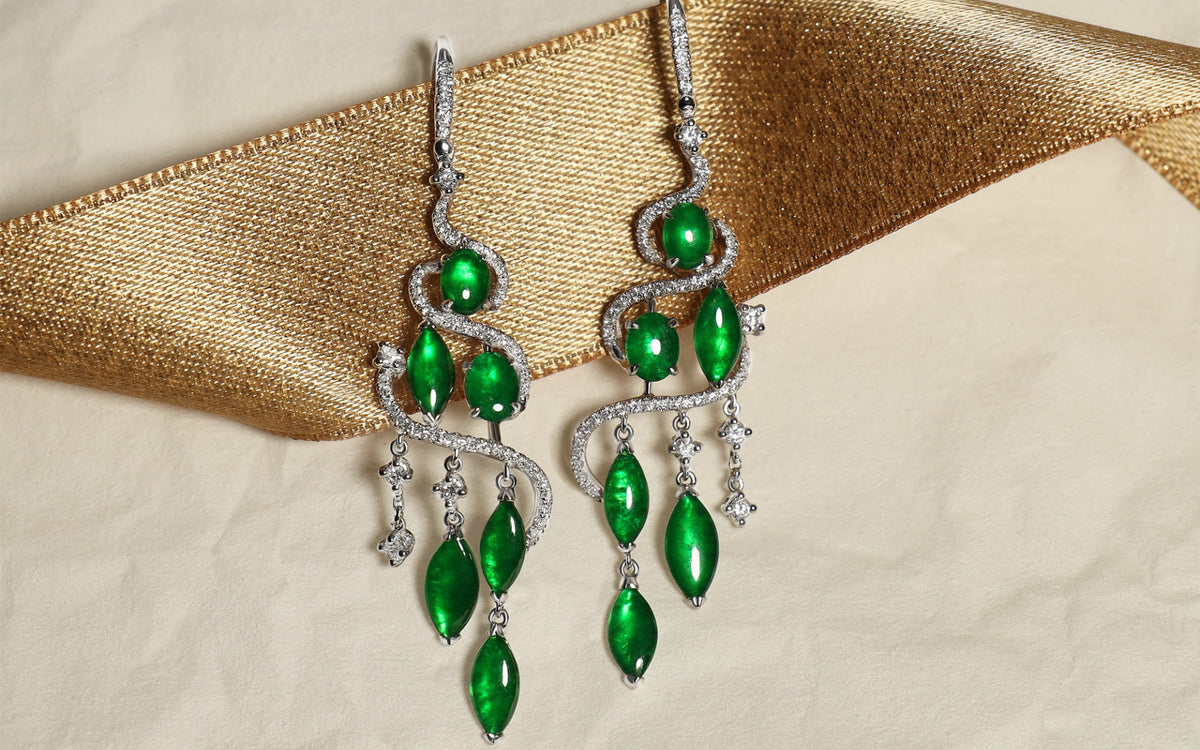
The SÈVE Standard
Jadeite is one of the few luxury materials in the world with no universal grading benchmark. Unlike diamonds — where the 4Cs provide a transparent, standardised framework — jadeite quality is assessed through five interlocking criteria that require trained eyes and uncompromising judgment. Without a knowledgeable and honest guide, a buyer has no objective measure to rely on. Every decision rests entirely on the seller's expertise and integrity.
This is where SÈVE's standard begins.
Type refers to the density and uniformity of jadeite's internal crystal structure — the single most important factor in evaluating a piece. It determines depth, luminosity, and durability. It is what separates enduring brilliance from surface-level appeal that fades.
There is a saying in the trade: laymen look at colour, experts look at type.
SÈVE works exclusively with old mine material (老坑) — distinguished by fine to medium crystal grain, tightly interlocking structure, and the characteristic depth it produces under light. These are qualities that cannot be replicated, enhanced, or substituted.
We do not work with new mine material.
Translucency describes how deeply light penetrates a stone and how it returns — what the trade calls water head (水頭). A piece with exceptional translucency appears to glow from within, possessing what the Chinese describe as: spirit, vitality, inner life (靈氣).
SÈVE selects only pieces with strong translucency — semi-transparent to transparent. A piece that reads as dry, flat, or opaque does not meet our threshold, regardless of its colour or size.
Colour is the most visible quality in jadeite, and the most frequently misrepresented. In the trade, green jadeite is assessed across four dimensions — and all four must be present simultaneously.
正 · Purity — The hue is a true, pure green. No grey, blue, yellow, or brown cast.
濃 · Richness — The saturation is full and deep. Not so pale it reads as watery; not so dark it turns towards black.
陽 · Brightness — The colour is vivid and alive. Not dull, flat, or grey-tinged.
均 · Evenness — The colour is distributed consistently across the stone. Concentrated patches, uneven zones, or abrupt colour breaks reduce value regardless of colour quality.
SÈVE carries exclusively bright to intense green jadeite. We do not offer light green, apple green, lavender, red, or yellow varieties — not because these colours lack beauty, but because our collection is built around a single, uncompromising standard of green.
Base refers to the cleanliness and fineness of the jadeite matrix — the parts of the stone beyond its colour. A strong base is clear, fine-grained, and free from cloudiness, heavy cotton formations, or distracting inclusions. It is what allows colour and translucency to express themselves fully.
A poor base undermines everything above it. SÈVE rejects pieces where base quality compromises the overall visual harmony of the stone, even when type and colour are individually strong.
Craftsmanship at SÈVE operates at two levels: the stone and the setting.
Every piece is worked by master craftsmen with decades of experience — artisans whose work is characterised by clean lines, precise proportion, and an intuitive understanding of how to honour a stone's natural character rather than work against it.
For setting, every SÈVE piece is mounted in 18K solid gold with natural diamonds. We do not use plated metals, filled gold, or diamond simulants. The construction is held to the same standard as the stone it carries.
Our designs are deliberately contemporary. SÈVE pieces are conceived to sit alongside modern fine jewellery. Every piece is designed to be worn now and inherited later.
With few exceptions, every SÈVE piece is one of a kind.
Old Mine (老坑)
A trade term for jadeite from secondary alluvial deposits — material naturally weathered, transported by water, and sorted over time. Often associated with fine grain structure and high translucency, but not a laboratory classification.
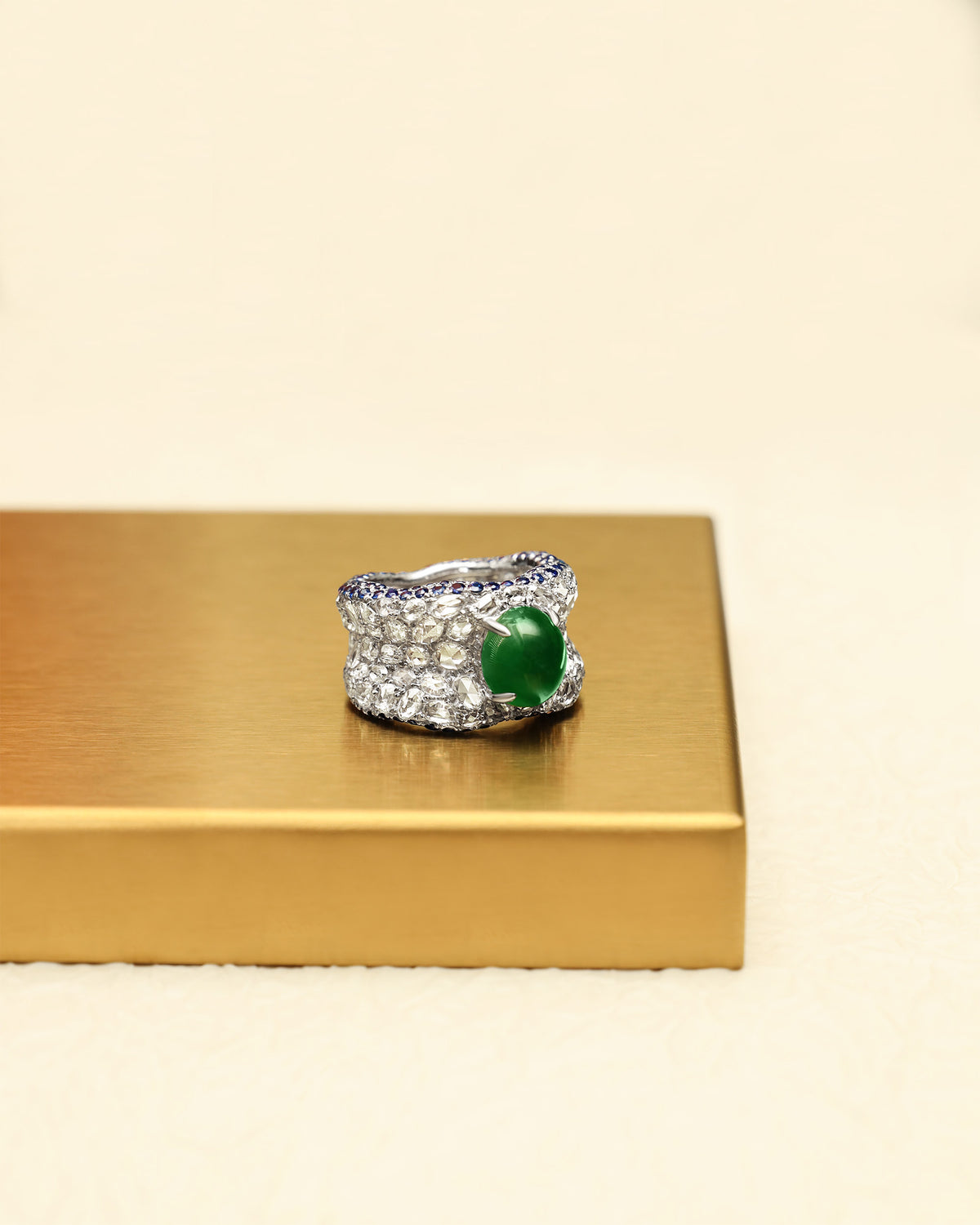
Why We Work Exclusively with Old Mine (老坑) Material
SÈVE sources exclusively from old mine (老坑) deposits. The natural sorting process that characterises alluvial jadeite results in a higher concentration of fine-grained, structurally sound material — the foundation for the translucency and colour integrity we prioritise in our selection.
The alluvial process acts as a natural filter: cracked, coarse, or structurally compromised material breaks down during weathering and transport. What remains in riverbeds tends to be denser, more tightly structured, and finer in grain.
Quality still varies significantly within old mine (老坑) material. Every piece SÈVE carries is evaluated individually against the five classical criteria: type (種), translucency (水), colour (色), base (底), and craftsmanship (工).
Colour is further assessed through the four classical standards — purity (正), richness (濃), brightness (陽), and evenness (均).
Deposit origin narrows the field.
Individual assessment determines what we accept.
Certification
Every SÈVE piece carries the Hong Kong Jade & Stone Laboratory certification confirming natural, untreated Type A jadeite. This is our baseline — the minimum condition for a piece to be considered. It is not our standard.
Type A certification tells you what a stone is not. Our curation tells you what it is.
Clients may request an independent Gemmological Report from GIA or Gübelin Gem Lab for any piece in the collection. This is the same standard of third-party verification commissioned by leading international auction houses. We coordinate the submission on your behalf.
This is the standard against which every piece is selected. For further context on jadeite grading, independent verification, or long-term care, the following resources are available.